
The “secret” passageway above the Ponte Vecchio
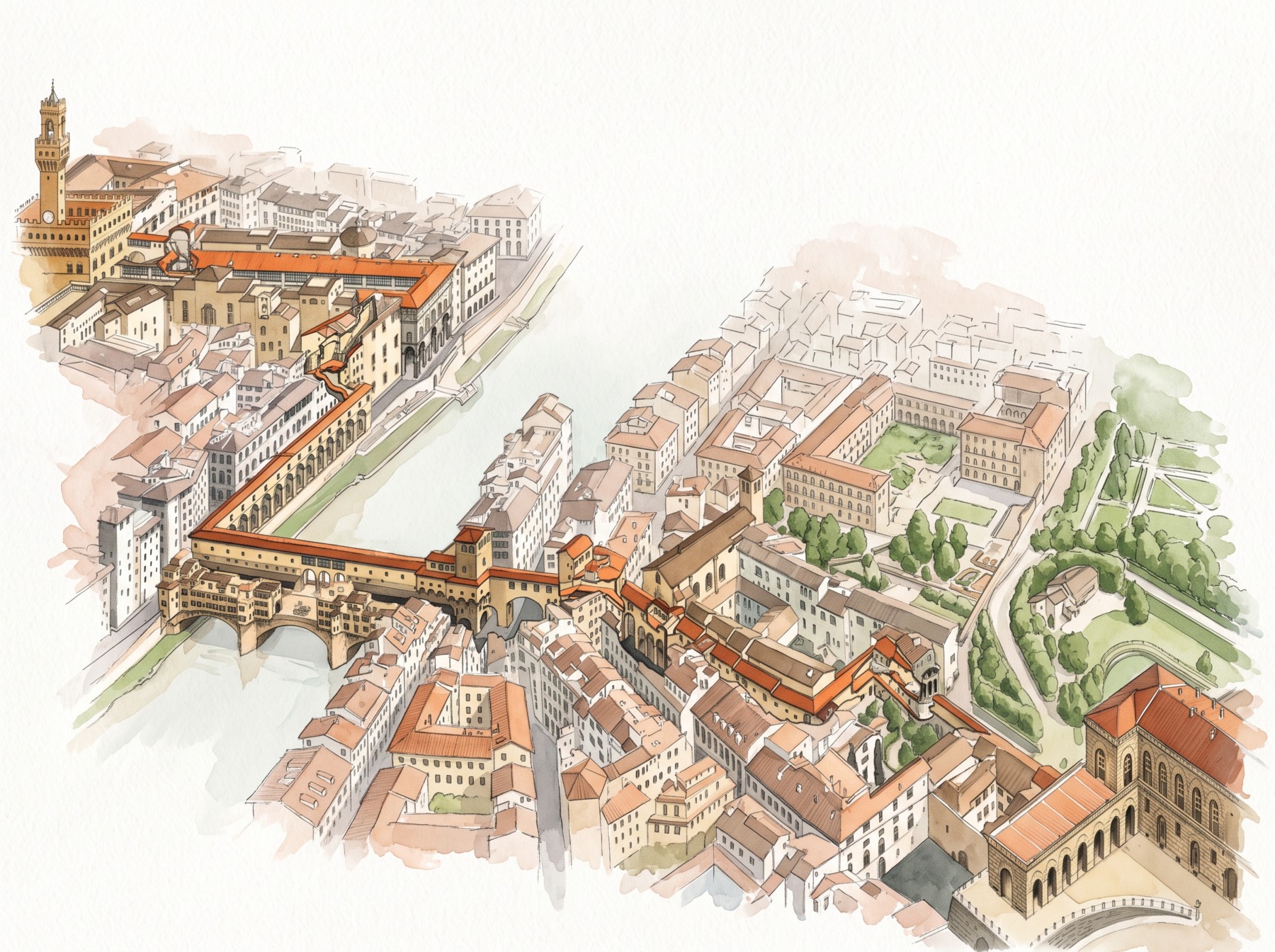
Corridor map
Every great city has a secret passage. Florence’s just happens to be about 750 meters long, sit atop its most famous bridge, and have 73 windows. Not exactly subtle.
A shortcut fit for a duke
In 1565, Grand Duke Cosimo I de’ Medici had a commuting problem. He worked at Palazzo Vecchio, the seat of government, but lived across the river at Palazzo Pitti. Walking to the office meant mingling with the public, which for a Medici with plenty of enemies was not ideal. On top of that, his son Francesco was about to marry Joanna of Austria, and nothing says “welcome to the family” like a brand-new private walkway.
So Cosimo turned to Giorgio Vasari: architect, painter, author of the famous Lives of the Artists and all-round Medici fixer. Vasari built the whole thing in just five months. (Anyone who has waited for roadworks to finish in Florence may find this hard to believe.)
The route: over, around and through
The corridor starts at Palazzo Vecchio, runs through the Uffizi, follows the Arno embankment and then crosses the river above the shops on the Ponte Vecchio. On the far bank it met its first obstacle: the Mannelli family flatly refused to knock down their medieval tower. Even a Medici couldn’t win that argument, so Vasari simply went around it on stone brackets. The detour is still there, a lovely monument to Florentine stubbornness.
Next, the corridor runs along the front of the church of Santa Felicita, where the Medici had a private balcony so they could attend Mass without sitting next to the neighbors. Finally, it comes out in the Boboli Gardens, beside Palazzo Pitti.
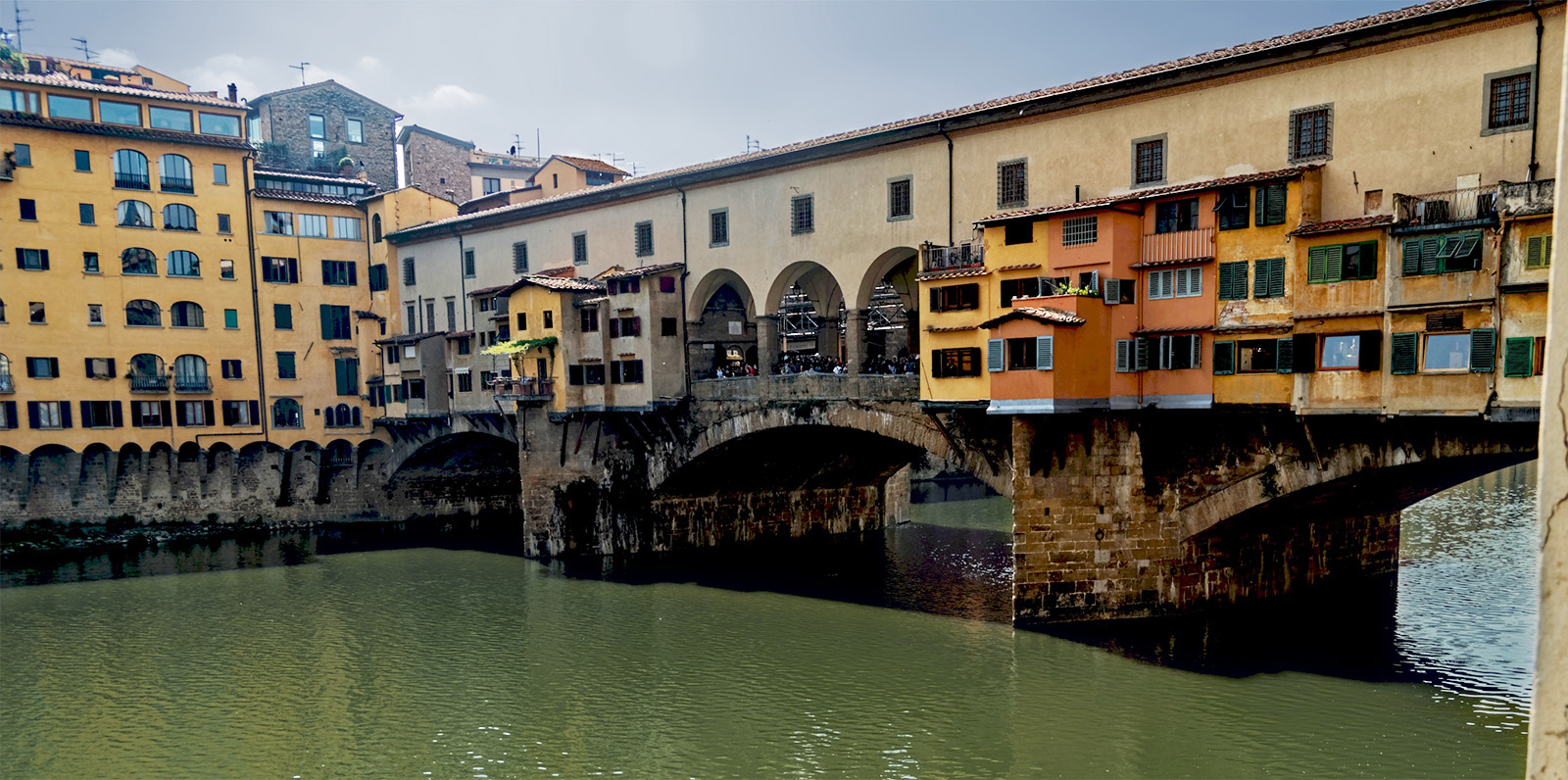
The corridor across the Ponte Vecchio
Why the bridge smells better than it used to
The Ponte Vecchio was originally lined with butchers, who found the river below a very convenient place to dispose of their scraps. Strolling above the smell of offal did not suit a grand duke, so in 1593 Ferdinando I evicted the butchers and brought in goldsmiths and jewelers instead. They’re still there, and these days the bridge smells mostly of money.
Dictators, war and a film
In 1938, Mussolini walked Adolf Hitler along the corridor during his visit to Florence. Legend has it that the large windows in the middle of the bridge were opened especially so the two could admire the view. Some historians now dispute this, but it remains one of the city’s favorite stories.
In August 1944, the retreating German army blew up every bridge in Florence except the Ponte Vecchio, though they destroyed the medieval buildings at both ends to block access to it. In those frantic days, the corridor became one of the few ways to get from one side of the city to the other. You can see this in the Florence episode of Roberto Rossellini’s 1946 film Paisà, where characters slip through an eerily empty Uffizi, its statues packed away for safety.
The corridor survived one more blow in 1993, when a Mafia car bomb exploded beside the Uffizi and damaged a number of the paintings hanging inside it.

The interior features antique marble busts
Can you walk it today?
Yes! After eight years of restoration, the corridor reopened to the public on December 21, 2024. The collection of artists’ self-portraits that once lined its walls has moved out, so today you see it much as the Medici did: plain walls, a few ancient sculptures and inscriptions, and those 73 windows framing the river and the rooftops.
A few practical tips:
- The corridor is sold as a supplement to an Uffizi ticket, and booking is required. Slots are limited, so reserve early on the official Uffizi website.
- Your Uffizi entry is two hours before your corridor slot, so you see the gallery first.
- It’s one way only, from the Uffizi to the Boboli Gardens, and takes about 45 to 60 minutes. There’s no turning back for a forgotten umbrella.
- Like the Uffizi, it’s closed on Mondays.
The corridor makes a wonderful extra if you stay in Florence. It drops you off in the Oltrarno, one of Florence’s best neighborhoods for a long, lazy lunch. Cosimo would approve.


Comments are closed.