How Italy Fell for Coffee: From Dancing Goats to the Perfect Espresso
“The finest organic suspension ever devised.” That’s how Captain Janeway of Star Trek: Voyager described coffee, and she was flying a starship across the galaxy on the stuff. Back here on Earth, no country has taken that idea more seriously than Italy.
Which is funny, because Italy grows practically no coffee at all, apart from a few heroic experimental plants in Sicily. Coffee needs tropical warmth and altitude, and Tuscany, for all its charms, is short on rainforest. So how did a country without a single plantation become the world’s most opinionated coffee nation? Pour yourself a cup. Here’s a short, caffeinated history.
Blame the goats
Coffee’s story begins in the highlands of Ethiopia, the original home of Arabica, the species most of us drink. (Robusta, its stronger and more bitter cousin, comes from central and western Africa.) Legend has it that a goatherd named Kaldi noticed his goats dancing around after nibbling red berries from a certain shrub, tried them himself, and was soon dancing too. It’s almost certainly not true, but it beats “botanists identified the presence of caffeine”.
The first reliable evidence of coffee as a drink comes from fifteenth-century Yemen, where Sufi mystics brewed it to stay awake through long nights of prayer. From there it spread across the Arab world and the Ottoman Empire. The Arabic word qahwah eventually gave us “coffee”, by way of the Turkish kahve and the Italian caffè.
Venice gets the buzz
Venetian merchants, who traded busily with the Ottomans, brought coffee to Europe around the start of the seventeenth century. At first it was sold as an expensive medicine. Not everyone approved: some churchmen called it the devil’s drink, and legend says Pope Clement VIII was asked to ban it. He tasted it first, liked it so much that he gave it his blessing instead. A wise man.
By most accounts, Europe’s first coffee house opened in Venice in 1645, and the idea caught on fast: about a century later the city had more than two hundred of them. Caffè Florian on Piazza San Marco has been pouring since 1720 and is still open, though its prices may get your heart racing faster than the espresso. Florence soon joined the party: Caffè Gilli, now in Piazza della Repubblica, traces its history back to 1733.
A nation in a hurry
For centuries, Italians brewed coffee much like everyone else. Then, at the end of the nineteenth century, they decided it was taking far too long. In 1884, Angelo Moriondo of Turin patented a steam-powered machine that could make large quantities of coffee quickly. In 1901, the Milanese engineer Luigi Bezzera patented a machine that brewed single cups on demand, and Desiderio Pavoni bought the patent and started selling them. “Espresso” was born: coffee made expressly for you, right now.
The finishing touch came in the late 1940s, when Achille Gaggia’s lever machines pushed water through the coffee at high pressure and created the golden foam on top, the crema. Customers were suspicious of it at first. Before long, nobody would accept an espresso without it.
At home, Italians got their own little miracle in 1933: the moka, the eight-sided stovetop pot launched by Alfonso Bialetti. It still sits on almost every Italian stove, gurgling away every morning, usually alongside a firm family opinion on exactly how full to fill it.
Coffee, Italian style, today
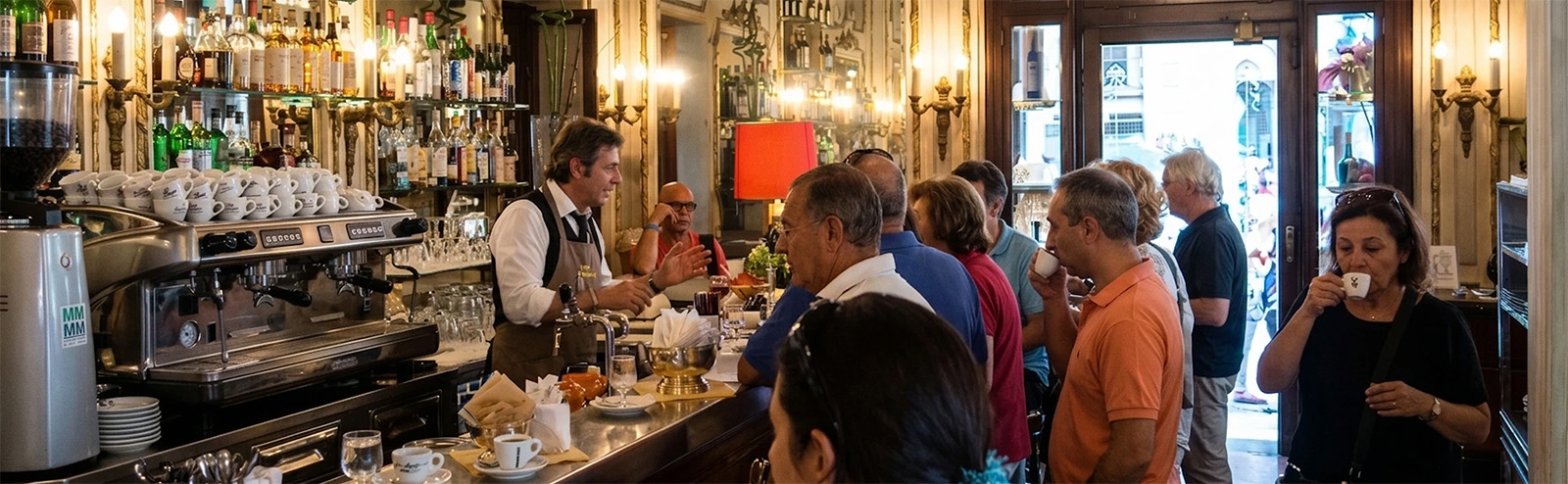
Today, coffee in Italy is less a drink than a ritual. Plenty of people skip breakfast at home and pop into the bar for a quick caffè and a cornetto, drunk standing at the counter, then come back for another after lunch, and maybe one more in the afternoon. Each visit lasts about as long as it takes to say “buongiorno”.
There are rules, of course, starting with the famous one about cappuccino after lunch. We’ve gathered them all in our guide How to Drink Coffee Like an Italian: Dos and Don’ts.
And if you join one of our cooking weeks, every morning starts with coffee at the villa. We can’t offer you a starship, but the view is out of this world.