
Driving in Italy: easier than you think (with a few surprises)
Say the words “rental car” and “Italy” together, and you might fear the worst: Roman traffic, a swarm of Vespas, a tiny car squeezing down a medieval alley, and an Italian behind you honking his horn.
Here’s the reassuring truth. Driving in rural Tuscany is nothing like driving in central Rome. Most of the time you’ll be on quiet country roads, between tranquil vineyards and olive groves. The distances driven during our cooking weeks are short; we encourage carpooling, and on the day we visit Florence, you leave the car behind and take the train.
That said, Italy does have a few rules and habits that will surprise a North American driver. Some of our guests rent a car just for their week with us; others keep it for a longer trip around Italy before or after their stay with us. Either way, this guide has you covered, from the paperwork you need before you leave home to the unwritten rules of the Italian road.
- Before you leave home: the International Driving Permit
- Renting the car
- The rules that are different
- Road signs: pictures, not words
- ZTL: the three letters to remember
- Parking: follow the colors
- The autostrada and tolls
- Fuel
- Italian driving habits, decoded
- Driving during your week with us
Before you leave home: the International Driving Permit
If you have a US or Canadian license, Italian law requires you to carry an International Driving Permit (IDP) together with your regular license. The IDP is simply an official translation of your license into several languages. Car rental desks don’t always ask to see it, but the police will if you’re stopped, and not having one after an accident can make things a lot more complicated. Every person who will drive needs their own.
For Americans: get your IDP from AAA, which is authorized by the US Department of State to issue it. You don’t need to be a member. You’ll need:
- a valid US driver’s license (and you must be 18 or older);
- two original passport-style photos (many AAA offices can take them);
- the application form and a $20 fee.
You can apply in person at a AAA branch that offers the service, or by mail. The permit is valid for one year and can be issued up to six months before the date you want it to start.
For Canadians: IDPs are issued only by CAA, to members and non-members alike. Bring your license, two passport photos and the fee (around C$30 plus tax, depending on your club). If you apply in person at a CAA store, you can often walk out with it the same day. It’s valid for one year.
One warning: ignore websites selling “international driver’s licenses” online. In the US, get it from AAA; in Canada, CAA is the only authorized issuer. Anything else may be worthless.
Renting the car
Automatic or manual? In Italy, manual (stick shift) is still the default, and unless you specifically book an automatic, that’s what you’ll get. Automatics are widely available, but there are fewer of them, so book early.
Think small. Country roads are narrow, village streets are narrower, and parking spaces seem measured for Fiat 500s. A compact car is far less stressful to drive than a big SUV. Do check it will take your luggage, though: two large suitcases may need something one size up, or a station wagon.
Gas, diesel, or electric? Diesel cars are much more common in Italy than in North America, and every gas station sells it alongside gasoline. When you book, you usually pick a car category rather than a specific model, so you won’t know which fuel your car takes until you collect it, and the person at the desk may not tell you. Always ask, and double-check the label inside the fuel flap.
Thinking of an electric car? Think twice. The villa has no charging station, and although Italy has plenty of public chargers, they’re few and far between in the Tuscan countryside. They’re also unattended, sometimes complicated to use, and many work only through the operator’s app or a charging card.
What you need at the counter: your license, your IDP, your passport, and a physical credit card in the main driver’s name (a debit card won’t do, as the company places a security hold on it). Drivers under 25 normally pay a young driver surcharge.
Insurance: in Italy, basic collision damage and theft protection are required by law and included in the rental price, usually with a deductible. Rental companies will offer extra cover to reduce that deductible. Don’t assume your credit card has you covered: many US and Canadian cards exclude Italy from their rental car coverage. Check with your card issuer before you leave.
Where to pick it up: you have two easy options.
- At the airport. The closest airports to the villa are Pisa and Florence, both about an hour’s drive away. Rome and Milan airports are around three to four hours away. At many airports, the rental companies aren’t in the terminal itself: just outside arrivals, look for the shuttle bus (navetta) to the car rental area. To compare prices, we recommend AutoEurope, a car rental broker that generally offers very competitive rates.
- At Certaldo station. Not keen on driving straight off a long flight? Take the train to Certaldo, our nearest town. It’s easy to reach from Pisa or Florence airports (both about an hour away) or from Rome and Milan (around three hours). Our local rental company can deliver the car you’ve booked to Certaldo station at 4 PM, and the timing can be adjusted if needed. From Certaldo, it’s just a quick 15-minute drive to the villa.
Before you drive off: walk around the car and take a video or photograph every scratch and dent, check the fuel policy (full-to-full is best), and make sure you know whether it takes gasoline or diesel. Italian law also requires a reflective vest and a warning triangle in the car; rentals come with them, but it doesn’t hurt to check.
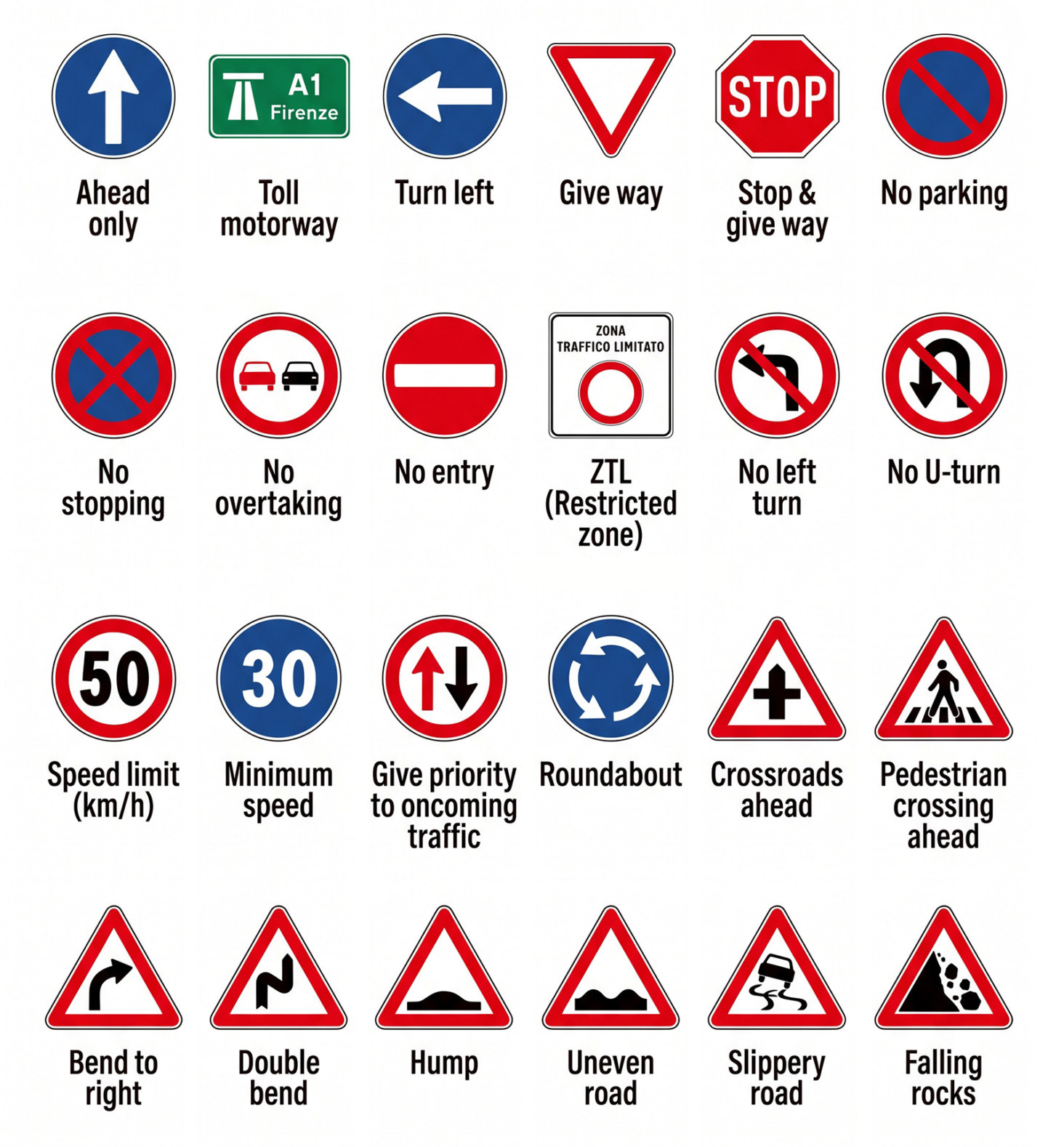
Road signs in Italy
The rules that are different
Speed limits are in kilometers per hour, and so is your speedometer. Unless signs say otherwise:
- Autostrada (toll motorway): 130 km/h (about 81 mph), 110 km/h in rain.
- Main highways outside towns: 110 km/h (about 68 mph), 90 km/h in rain.
- Other roads outside towns: 90 km/h (about 56 mph).
- In towns: 50 km/h (about 31 mph), and sometimes 30 km/h.
Speed cameras are everywhere. Fixed cameras (autovelox) must be announced by a warning sign. You won’t be pulled over. Instead, the fine is sent to the rental company, which passes it on to you months later, plus an administration fee.
A few more rules worth knowing:
- Headlights on outside towns at all times, day and night, including on the autostrada.
- No right turn on red. Ever. Red means stop and wait, however empty the road looks.
- Rotatories/roundabouts: traffic already on the roundabout has priority. Watch for the give-way signs and enter when there’s a gap.
- Keep right. The left lane is for passing only. If a car appears in your mirror flashing its headlights, it isn’t saying hello; it would like you to move over.
- Put the phone down. Since December 2024, holding a phone while driving can cost €250 to €1,000. Use a hands-free mount.
- Seat belts for everyone, front and back.
- Cyclists: Tuscany is full of them, especially on weekends, and the law now requires you to leave at least 1.5 meters (about 5 feet) when passing them.
- Alcohol: the limit is 0.5 grams per liter (0.05%), lower than the US limit of 0.08% and in line with many Canadian provinces. On outing days, choose a designated driver.
Road signs: pictures, not words
Most road signs are pictures, not words, and they follow the same European system all over Italy. A red circle means something is forbidden; a blue circle means something is required; a triangle means watch out. Here are a few:
ZTL: the three letters to remember
Most historic centers in Tuscany, from cities like Florence, Siena, and Lucca to small hill towns, are ZTL zones (Zona a Traffico Limitato): restricted traffic areas where only residents and authorized vehicles can drive.
The entrance is marked by a white sign with a red circle and the letters ZTL, often with an electronic panel that says varco attivo (gate active) when the restriction is on. There’s no barrier, just a camera. Drive past it, and the camera photographs your plate. Weeks or months later, the fine reaches you through the rental company, plus their administration fee. Drive in and out past several cameras, and you can collect several fines in one afternoon.
The fix is easy: park outside the town walls, in the pay parking areas marked with a big P, and walk in.
Staying in Florence? If your hotel, or a garage you’ve booked, is inside the ZTL, it can usually add your rental car’s license plate to the city’s “white list” (lista bianca), so passing the camera on your way in doesn’t earn you a fine. It isn’t automatic, though: ask the hotel before you book whether they offer it, give them your plate number as soon as you arrive, and check which gate (varco) to use. The registration covers getting to your hotel or garage, not driving around the center, and each new trip through a gate counts separately. Small B&Bs and apartment rentals often can’t register plates at all.
Parking: follow the colors

Parking symbols in Italy
The color of the lines tells you everything:
- Blue lines: paid parking. Pay at the meter or with a parking app, and leave the ticket on the dashboard.
- White lines: it depends on the town. In many places, they mean free parking. But not everywhere: in Florence, for example, white-lined spaces are reserved for residents.
- Yellow lines: reserved for residents, disabled drivers, or deliveries. Don’t, however tempting.
Whatever the color, always read the sign at the start of the street or at the car park entrance. It tells you when the rules apply, how long you can stay, and how to pay. On white lines, there’s sometimes a time limit, and you’ll need a parking disc (disco orario) on the dashboard, set to your arrival time. On blue lines, you usually pay only during set hours, typically daytime from Monday to Saturday, so parking is often free in the evening, on Sundays and on public holidays. The sign will tell you.
- Parcheggio a pagamento: paid parking.
- Feriali (or a symbol of two crossed hammers): Monday to Saturday. Yes, Saturday counts as a working day.
- Festivi (or a small cross symbol): Sundays and public holidays
- Escluso festivi: except Sundays and public holidays (parking is free then)
- 8–20: the hours the rule applies, here 8 AM to 8 PM
- 0–24: the rule applies all day and all night
- Sosta max 1 ora con disco orario: maximum 1 hour, display your parking disc. A parking disc (disco orario) is a small cardboard or plastic clock. You turn the dial to the time you arrived and leave it on the dashboard. If your rental car doesn’t have one, a piece of paper reading “Ora di arrivo” followed by your arrival time, left clearly visible on the dashboard, is generally accepted.
- Eccetto residenti: residents only
- Eccetto autorizzati: permit holders only
- Rimozione forzata: tow-away zone. Your rental car will be towed.
- Pulizia strade: street cleaning. No parking on the day and at the hours shown.
The autostrada and tolls
First, a color twist: in Italy, green signs point to the autostrada and blue signs to other main roads, the opposite of what you might expect.
Most autostrade are toll roads. Take a ticket when you enter, then pay when you exit. At the toll booth, avoid the yellow lanes marked Telepass (they’re for electronic tags only) and choose a lane with a card symbol or a cash symbol. Cards work fine; see our guide on how to pay in Italy.
The main road between Florence and Siena, and the one between Pisa and Florence (FI-PI-LI), the ones you’ll most likely use to reach us, have no tolls.
Fuel
At many stations you can choose between self/fai da te (self-service, cheaper) and servito (an attendant fills up for you, for around 15 cents more per liter). If you opt for self-service, you will typically pay at an automated machine using cash or a card. Be sure to know your card’s PIN, as these machines frequently require it. At the pump, gasoline is usually labeled Benzina, Super or Super senza Pb (senza piombo means unleaded). Diesel is Diesel or Gasolio. Putting the wrong one in is an expensive way to end a road trip, so check the label inside the fuel flap before you fill up. Brands also sell premium fuels with fancier names, like V-Power, Blue Super or Excellium, for 10 to 20 cents more per liter. Save your money. Regular unleaded (or regular diesel) is all a rental car needs.
Italian driving habits, decoded
Tailgating is practically a national sport. Don’t take it personally, and don’t feel pressured to speed up. Simply pull over when it’s safe and let the other driver pass. A flash of headlights usually means “I’m coming through” rather than “after you”, so don’t mistake it for a polite invitation. In towns and cities, keep an eye on your mirrors: nimble motorini (scooters) have a knack for squeezing through the smallest gaps and slipping between lanes of traffic.
Driving during your week with us
Our villa sits in central Tuscany, about 45 minutes from Florence, an hour from Siena and half an hour from San Gimignano. Unlike many rural properties around here, it’s right off a paved road, not at the end of miles of winding dirt track, and there’s plenty of room to park.
During the week, the drives to our excursions are short, and most of the time you’ll simply follow one of us. On our Florence day, you’ll take the train from nearby Certaldo, and our guide will meet you at the other end: no city traffic, no ZTL, no parking stress. We’ll give you a booklet with step-by-step visual directions, plus Google Maps pins for all the places worth seeing nearby. For more practical details, see our FAQ.
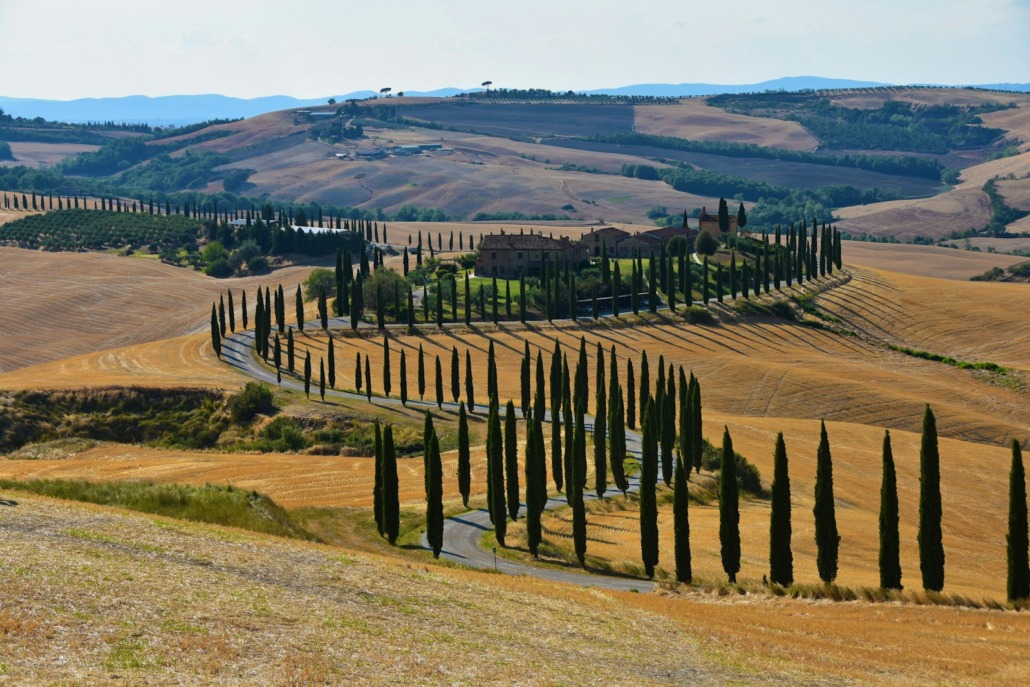
Give it a day, and you’ll find driving in Tuscany is one of the great pleasures of the trip: a curve, a cypress-lined road, a hill town on the horizon, and nobody in a hurry except the car behind you. Buon viaggio!

