
Semifonte: the Tuscan town Florence wiped off the map (and the little dome It left behind)
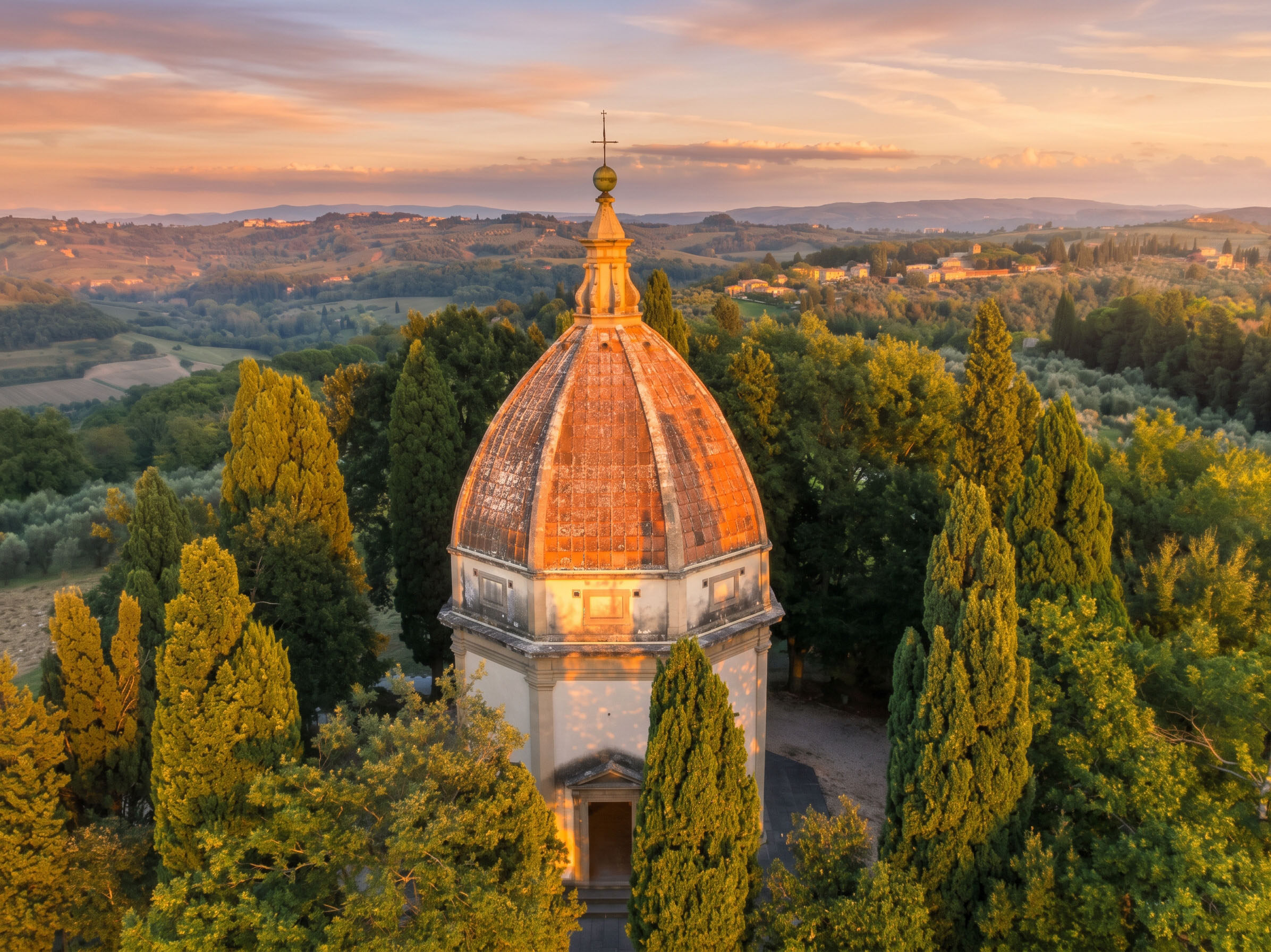
Aerial view of Semifonte at dusk
From the villa where we hold our cooking classes, you can spot it on the skyline: a little dome standing alone on a hilltop, like a piece of Florence that wandered off into the countryside. It looks like a miniature of Brunelleschi’s famous dome because that’s exactly what it is. And the hill it stands on was once a whole city that Florence wiped off the map. This is the story of Semifonte, the Tuscan town that grew too big, too fast.
Why Tuscan towns live on hilltops
Certaldo, Barberino Val d’Elsa, San Gimignano: almost every old town around here sits on top of a hill, and that’s no accident. In the Middle Ages, the valley floors were often marshy, damp and unhealthy, while the hilltops had cleaner air, better views and, crucially, a big head start on anyone trying to attack you. Tuscany was then a patchwork of independent cities and feudal lords who were frequently at war with one another, so a hill was the medieval equivalent of a good security system.
Semifonte sits on one of the highest points in the area. On a clear day the view runs all the way around: San Gimignano’s towers, Barberino, the villages of Marcialla and Fiano, and rolling hills in every direction. Its builders clearly knew a good location when they saw one.
A town named after a spring
The name most likely comes from the Latin Summus Fons, the “highest spring” or “spring at the summit” (think of the English words summit and fountain). Over the centuries it went through a few spellings, including Summofonte and Simifonti, before settling on Semifonte.
The upstart that worried Florence
Around 1177, Count Alberto IV degli Alberti, a powerful feudal lord allied with the Holy Roman Emperor, built a fortified town on this hill. The location was perfect: it overlooked the Elsa valley and the roads that ran through it, including the Via Volterrana and a stretch of the Via Francigena, the great pilgrim route from Canterbury and France to Rome. Roads meant travelers, travelers meant trade, and trade meant tolls.
Semifonte grew quickly. Historians now estimate its population at around 1,500 people, which doesn’t sound like much today but made it a serious town for the time. It had walls, towers, churches and ambitions. And just 30 kilometers (about 19 miles) away, Florence was watching.
Florence was expanding its control over the countryside, and an imperial stronghold sitting on its trade routes, run by a count it didn’t trust, was not part of the plan. Dante, writing about a century later, still remembered the rivalry. In the Paradiso he complains about newcomers who had become rich Florentine merchants but would have been better off going back to Semifonte, “là dove andava l’avolo a la cerca”, where their grandfathers used to go begging. A Florentine insult, served cold, a hundred years later.
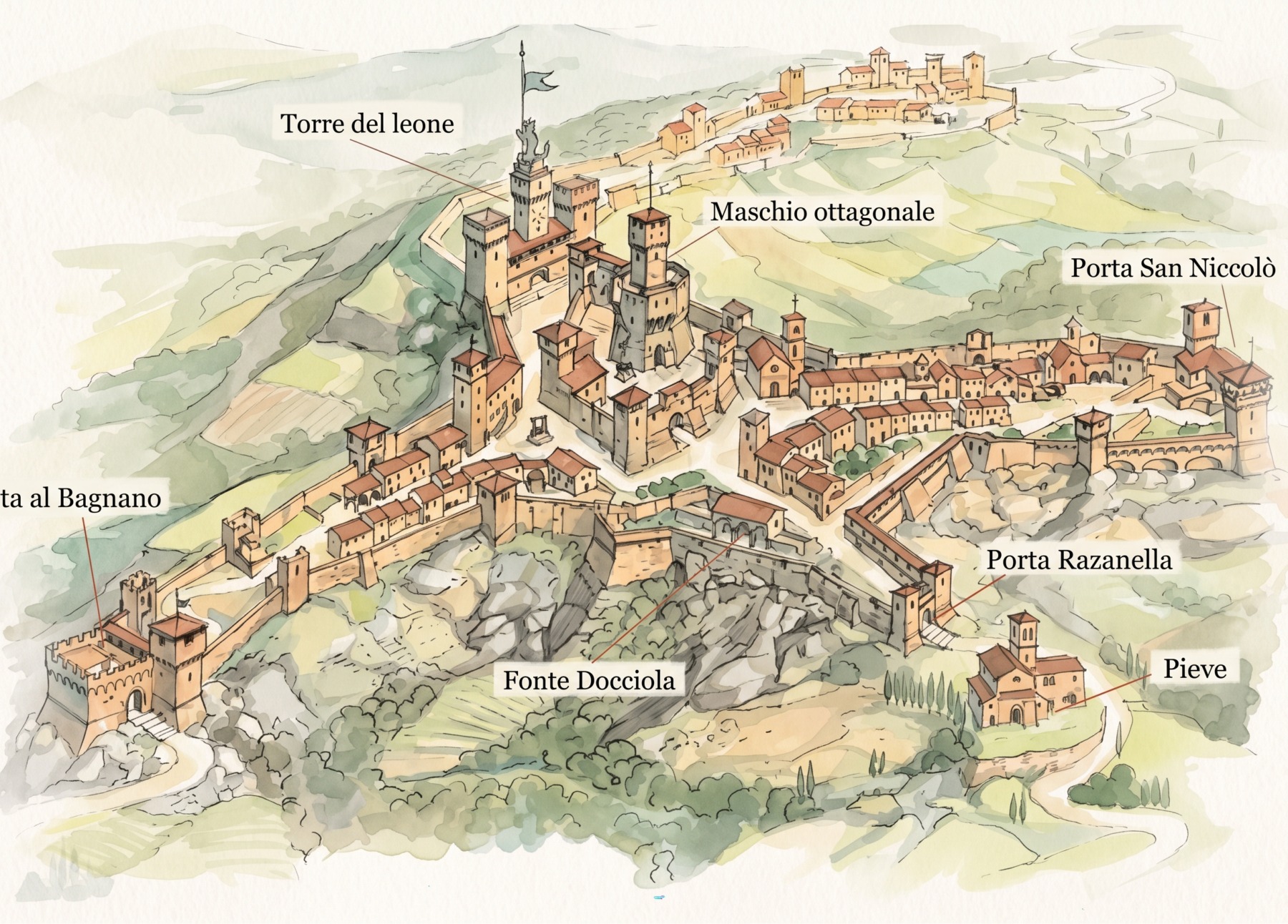
A visual reconstruction of Semifonte
Four years of siege and one open gate
In 1198, Florence went to war with Semifonte. The siege that followed lasted, on and off, for four years. Like most medieval sieges, it wasn’t a non-stop battle but a long, grinding effort to surround the town, cut off supplies and wait for hunger to do the work. Florence also worked on the diplomatic side: in 1201 it signed a peace treaty with Siena that left Semifonte without its most useful potential ally.
In March 1202 the end came. According to local tradition, a traitor opened one of the gates; historians suggest it was more likely a group of exiles who let the Florentine troops in through the Porta Romana. Either way, Semifonte surrendered, and on 3 April 1202 the terms were written up.
Erased, stone by stone
Florence spared the inhabitants’ lives, but not their town. The citizens of Semifonte were ordered to demolish it themselves: walls, towers, houses and even churches. Florence offered some money to help them resettle on the plain below, where no fortifications were allowed, but the spot was so uninviting that most people simply left. Many moved to San Gimignano and other towns in the Elsa valley, and some to Florence itself.
Then came the final touch: a decree that nothing could ever be built on the hill again.
Two famous stories add some drama. One says that the stones of Semifonte were carried to nearby Barberino Val d’Elsa and used to build its walls. Another says the Florentines scattered salt on the ground so that nothing would ever grow there again, a symbolic gesture of total eradication. Both are great stories, and both are probably more legend than fact (the salt story is told about several defeated cities, going all the way back to ancient Carthage). What is certain is that Semifonte disappeared, and the hill stayed empty for almost 400 years.
Four centuries later: a chapel with special permission
Fast forward to the late 1500s. Tuscany is no longer a battlefield of rival cities. Florence has absorbed Siena, and most of the region is now the Grand Duchy of Tuscany, ruled by the Medici, the banking family turned dynasty (the same people who built a private corridor over the Ponte Vecchio so they wouldn’t have to mix with the crowds). Peace has broken out, and wealthy Florentine families are building villas and chapels in the countryside.
One of them was the Capponi family, prominent Florentine merchants and bankers. Around 1588, Giovan Battista Capponi, a canon of Florence Cathedral and owner of the Renaissance villa in the nearby hamlet of Petrognano, decided he wanted to build a chapel on the empty hill of Semifonte, dedicated to Saint Michael the Archangel. There was just one small problem: Florence’s ban from 1202 was still in force. Medieval grudges, it turns out, come with a very long shelf life.
So Capponi did what you did in those days: he petitioned the Grand Duke, Ferdinando I de’ Medici. After some years of waiting, permission was granted around 1594. The design was entrusted to Santi di Tito, one of the leading painters and architects in Florence at the time, and the chapel was completed in 1597 by the canon’s nephew, Neri Capponi. It remains the only building ever allowed on the hill.
The original: Brunelleschi’s dome
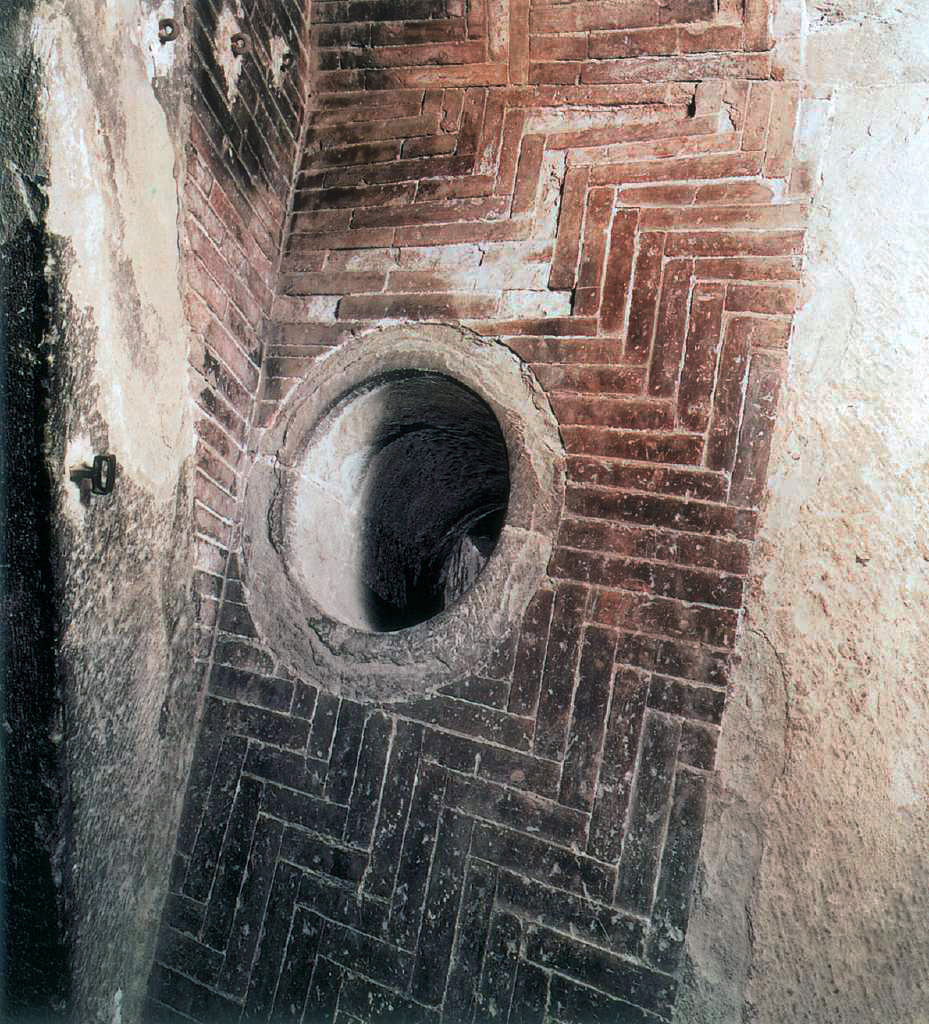
Brunelleschi’s dome with its herringbone-patterned brickwork
To understand why this little chapel matters, we need to go back to Florence. At the end of the 13th century, the city, one of the richest in Europe, started building a cathedral big enough to show off its wealth and power: Santa Maria del Fiore. Work began in 1296, and by the early 1400s almost everything was done except for one rather important detail: the roof. The space to be covered by the dome was about 45 meters (nearly 150 feet) across, and nobody knew how to do it.
The usual method was to build a huge wooden framework to support the dome while it was under construction. For a dome of this size, that would have required an absurd amount of timber and money, and might not have worked anyway. So in 1418 the city announced a competition.
The winner was Filippo Brunelleschi, a goldsmith turned architect, who had spent years in Rome measuring and studying ancient Roman buildings. According to Giorgio Vasari, he refused to show his rivals his model and instead challenged them to make an egg stand upright on a marble table. When they all failed, he tapped the egg on the table, flattening its end, and stood it up. When they protested that they could have done that, he replied that they would also say they could build the dome once they had seen his plans. It’s probably a legend, but it’s a good one.
His actual plan was audacious: a dome that would support itself as it rose, with no wooden framework underneath. He built it with two shells, an inner one and a lighter outer one, and laid the bricks in a herringbone pattern so that each new course locked into the one below. Like any good cook trying a new recipe, he seems to have done a test run first: according to tradition, he tried out his method on a small dome in the Ridolfi Chapel of the church of San Jacopo sopr’Arno, although historians aren’t sure it was really his work. Construction began in 1420, and the cathedral was consecrated in 1436. Nearly six centuries later, it is still the largest brick dome ever built, and still the defining feature of Florence’s skyline.
Florence’s dome, one-eighth size
The Capponi wanted to honor that achievement, and it’s easy to see why: Giovan Battista was a canon of the very cathedral the dome sits on. So the chapel of Saint Michael at Semifonte was built with an octagonal plan, and its dome is a replica of Brunelleschi’s, built at a scale of 1 to 8.
There’s a nice twist to the story. Florence destroyed Semifonte to keep it off the map forever. Four hundred years later, the only building allowed on its hill is a small tribute to Florence’s greatest monument. You could call it the final word in an old rivalry, or a very elegant peace offering.
Semifonte today
Today the hill above the hamlet of Petrognano is quiet farmland. Apart from the chapel, there is little left of the medieval town: a few traces of the walls and the stump of a tower from one of its old gates. But the little dome is hard to miss, and once you know the story, you’ll keep looking for it on the horizon.
If you join us for a cooking class at the villa, take a moment between rolling the pasta and sitting down to lunch to look out across the valley. That small dome on the hill is Semifonte: a city that challenged Florence, lost everything, and ended up with a miniature version of Florence’s most famous dome as its monument.

