All roads lead to Rome, or so they say. In the Middle Ages, one of them did the job better than most. The Via Francigena, “the road that comes from France”, carried pilgrims, merchants, armies and the occasional archbishop from northern Europe over the Alps and down the length of Italy to the tombs of Saints Peter and Paul.
Its Tuscan stretch runs for just under 400 km (about 245 miles), from the Cisa Pass in the Apennines to the border with Lazio. It is the Tuscany of postcards: walled hill towns, cypress-lined ridges, Romanesque churches and plenty of good excuses to stop for lunch. After centuries of neglect, the old road is now enjoying a second life as one of Europe’s great long-distance walks. Here is the story of both lives.
A road with many names
The road is older than its name. In the 6th and 7th centuries the Lombards, who then ruled much of Italy, used a route over the Cisa Pass to link their capital, Pavia, with their lands in Tuscany while staying clear of Byzantine territory. The name “Via Francigena” first appears in a parchment of 876, the Actum Clusio, kept at the abbey of San Salvatore on Monte Amiata.
Medieval travelers had a word for every destination. Dante, in his Vita Nuova, explains that those going to Jerusalem were palmieri (they came home with palm leaves), those going to Santiago were peregrini, and those going to Rome were romei. That is why parts of the route were also called the Via Romea. And it was never a single paved highway: it was a bundle of tracks that shifted with wars, floods, politics and whichever saint’s relics happened to be in fashion.
An archbishop’s travel diary
Most of what we know about the early route comes from Sigeric, Archbishop of Canterbury, who traveled to Rome in 990 to receive the pallium, the woolen stole of his office, from Pope John XV. On the way home, someone in his party listed every overnight stop: about 80 of them, at an average of some 20 km (12 miles) a day, for a total of roughly 1,700 km (1,050 miles). The list survives in a manuscript at the British Library. Since it was written on the way back, today’s walkers heading for Rome are technically following Sigeric in reverse.
The spelling is creative, but the Tuscan stops are easy to recognize: Puntremel (Pontremoli), Luca (Lucca), Arne Blanca (Fucecchio, on the Arno), Sce Gemiane (San Gimignano), Burgenove (Badia a Isola, near Monteriggioni), Seocine (Siena), Sce Quiric (San Quirico d’Orcia) and Sce Petir in Pail (San Pietro in Paglia, near the Lazio border).
The Tuscan stretch, north to south
Over the Apennines. The road enters Tuscany at the Cisa Pass and drops into the Lunigiana valley at Pontremoli. It then heads for the coast near the ruins of Roman Luni, briefly dipping into Liguria, and runs south through Massa and Camaiore, between the Apuan Alps and the sea.
Lucca. Medieval pilgrims came here to see the Volto Santo, the “Holy Face”, a large wooden crucifix kept in the cathedral of San Martino. It was so famous that England’s King William II, according to the chronicler William of Malmesbury, liked to swear “by the Holy Face of Lucca”.
Altopascio. In the 11th century a hospital for travelers was founded here, run by the Knights of the Tau (the Order of St James of Altopascio). Every evening, from half an hour before sunset to half an hour after, they rang a bell called La Smarrita, “the lost one”, to guide pilgrims who had strayed into the surrounding woods and marshes. In 1244 Emperor Frederick II also made them responsible for a bridge over the Arno near Fucecchio, with a ferry if the bridge washed away. Customer service, medieval style.
Across the Arno to the Elsa valley. After crossing the river at Fucecchio, the road climbs to San Miniato, then winds through the hills to Gambassi Terme and San Gimignano. San Gimignano grew rich on pilgrim traffic and the saffron trade, and its families spent the money on tower after tower, which explains the medieval Manhattan you see today.

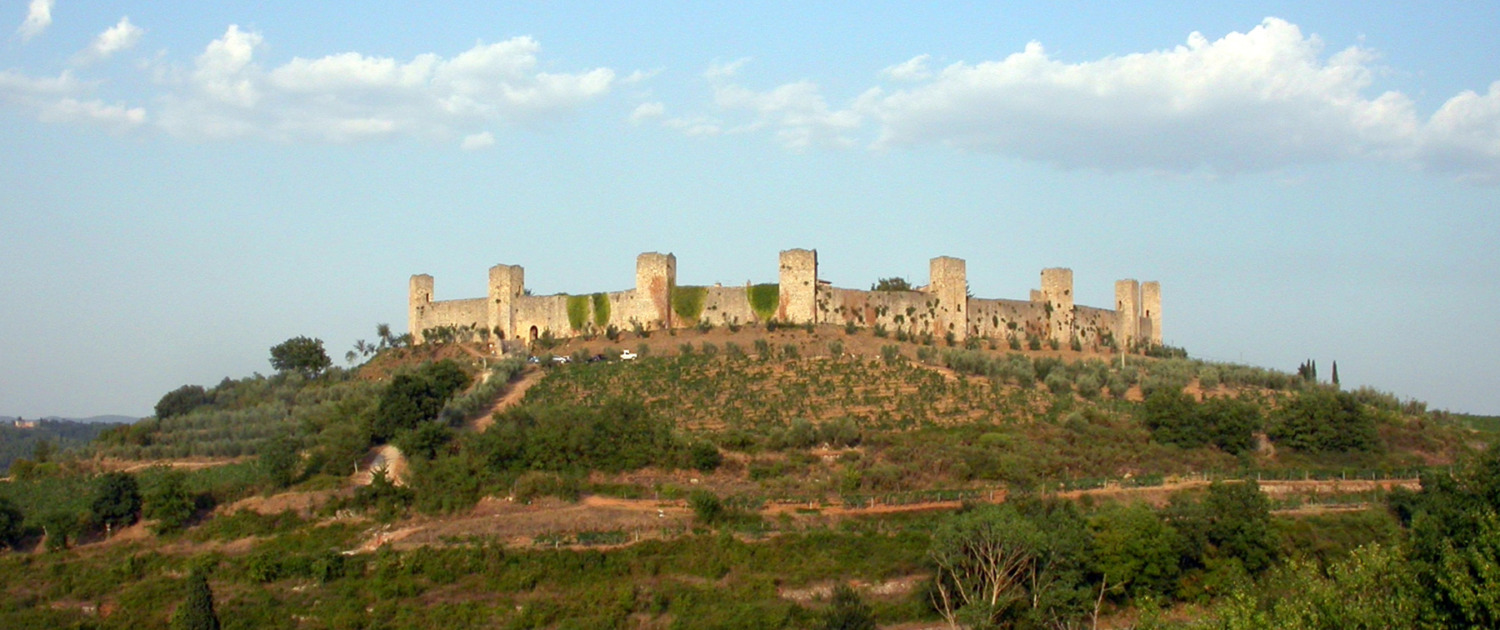
Monteriggioni, still wearing its crown of towers. Photo: Wikimedia Commons (CC0).
Monteriggioni. Siena built this walled village from 1213 to guard the road against Florence. Its ring of towers made such an impression that Dante, in the Inferno, compared it to giants standing around the edge of a pit. Walking in through the gate on foot, you will understand why.
Siena. Opposite the cathedral stands Santa Maria della Scala, one of the oldest hospitals in Europe, documented from the late 11th century. It was founded to look after pilgrims, the sick and abandoned children. Its great hall, the Pellegrinaio (pilgrims’ hall), is covered in 15th-century frescoes showing daily life in the hospital, from bandaging wounds to handing out bread. Today it is a museum.

Domenico di Bartolo, The Care of the Sick, 1440s, in the Pellegrinaio of Santa Maria della Scala, Siena. Public domain.
The Val d’Orcia. South of Siena the road crosses the Crete Senesi and enters the Val d’Orcia, a UNESCO World Heritage landscape since 2004. Pilgrims stopped at San Quirico d’Orcia, Sigeric’s Sce Quiric. Nearby Bagno Vignoni is a village whose main square is a pool of hot spring water: a very welcome sight for tired legs.

The thermal pool in the main square of Bagno Vignoni. Public domain.
Radicofani. The last big climb in Tuscany leads to a fortress that was once the lair of Ghino di Tacco, the 13th-century “gentleman bandit”. Giovanni Boccaccio, born in our own Certaldo, tells in the Decameron how Ghino kidnapped the Abbot of Cluny on his way to take the waters, cured his stomach ache with toasted bread and Vernaccia wine, and ended up reconciled with Pope Boniface VIII, who made him a Knight Hospitaller. From Radicofani the road descends toward the border and on into Lazio.
The revival: the “other Camino”
With railways and highways, the old road was largely forgotten. Its rediscovery began in the late 1980s, when the researcher Giovanni Caselli traced Sigeric’s route on the ground. In 1994 the Council of Europe declared the Via Francigena a Cultural Route, and in 2004 a Major Cultural Route. In 2001 the towns along the way founded the European Association of the Vie Francigene, based in Fidenza, which now looks after waymarking, the pilgrim credential and much more.
Tuscany has invested more than most. Its section is fully waymarked and divided into 16 stages, with hostels, B&Bs and farm stays along the way, and it is the most walked of the seven Italian regions the route crosses. Then came the 2025 Jubilee: according to the association, more than 19,000 credentials were issued, about 36% more than in 2024, and more than 12,000 walkers collected their Testimonium in Rome. Since only a fraction of walkers carry a credential, the association estimates that around 100,000 people walked at least part of the route, and more than half came from abroad.
The Camino de Santiago is still the champion, with around half a million pilgrims a year. But that is part of the Francigena’s charm. You will share the path with far fewer people, and with more olive groves, vineyards and medieval villages. The next step may be the biggest yet: in July 2025, with Tuscany as lead region, Italy sent UNESCO the first document for a World Heritage candidacy for the Italian section of the route.
If you want to try it: pick up a pilgrim credential, the “passport” you get stamped along the way. If you walk at least the last 100 km to Rome (or cycle the last 200 km), you can collect the Testimonium, the certificate of your pilgrimage, at St Peter’s. Spring and autumn are the best seasons. Summer in the Val d’Orcia is beautiful, but it is hot, and shade is in short supply.
The route passes just a few kilometers from our cooking school near Certaldo, and the stage from Gambassi Terme to San Gimignano, about 13 km, is one of the loveliest in Tuscany: vineyards, woods, a Romanesque church and those towers slowly rising on the horizon. If you are joining us for a cooking week in Tuscany, ask us about it.